
What affects your personal loan EMI? See 8 real factors, live rate data, and a free calculator to find your exact monthly payment. It is the output of eight variables working together, and most borrowers only understand two of them.

As of June 2026, the average personal loan rate sits at 12.28% for a borrower with a 700 credit score on a $5,000, three-year loan (Bankrate, 2026). Move any single input, credit score, tenure, or loan amount, and that number shifts fast.
Most guides stop at “credit score and interest rate matter.” That’s true, but incomplete. It skips the trade-off math that actually decides what you pay every month, and what you pay in total.
This guide walks through every factor that touches your EMI, in the order lenders actually weigh them, with the real numbers behind each one.
Key Takeaways
- Loan amount, interest rate, and tenure set your base EMI, but credit score decides which rate you’re even offered.
- Borrowers with 720+ credit scores averaged a 14.58% rate in July 2026, versus 19.04% for the 690-719 tier (NerdWallet, 2026).
- A 5-year tenure can nearly double your total interest versus a 3-year tenure on the same loan.
- Keeping total debt obligations under the 36% DTI mark improves both approval odds and pricing (Bankrate, 2026).
What Is a Personal Loan EMI?
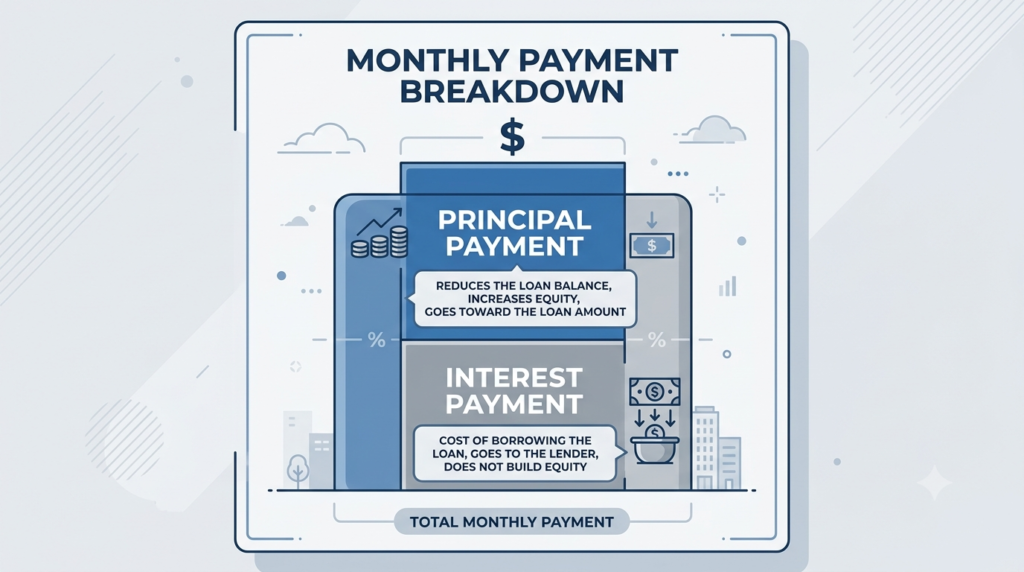
EMI stands for Equated Monthly Instalment: the fixed monthly payment that clears your loan by the end of its tenure. Each EMI splits into principal, the amount borrowed, and interest, the cost of borrowing it.
Early payments skew heavily toward interest. Later payments skew toward principal. This is standard amortization behavior on every reducing-balance loan, not a hidden fee or lender trick.
You can see this split instantly on our personal loan calculator. Enter your amount, rate, and tenure, and the tool returns your exact EMI plus a full month-by-month breakdown.
Affects Your Personal Loan EMI
1. Loan Amount: The Base Multiplier
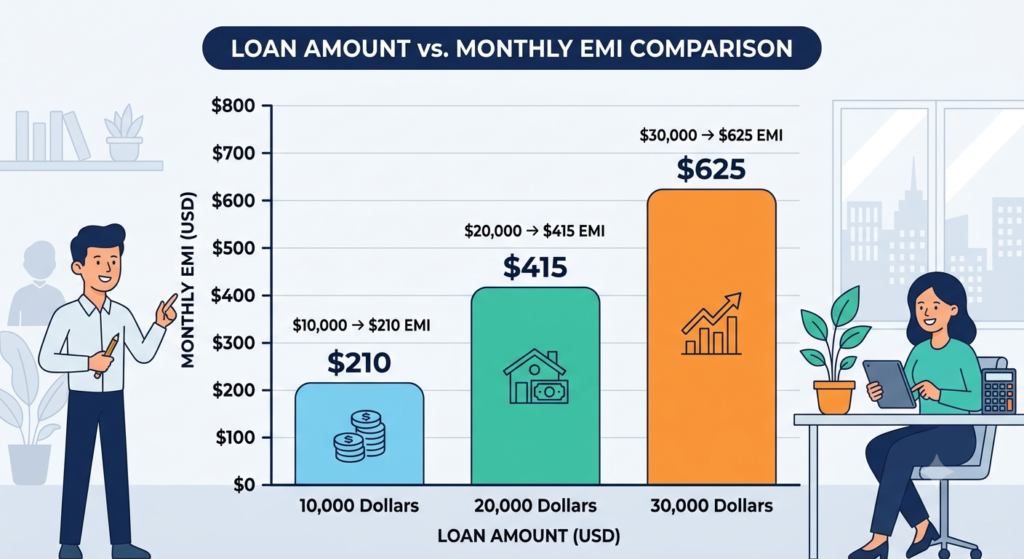
Loan amount is the most direct input into your EMI. Double the principal at the same rate and tenure, and your EMI roughly doubles too.
[CHART: Bar chart – EMI at $10,000 vs $20,000 vs $30,000 loan amount, same 12% rate and 3-year term – source: internal calculation]
A $10,000 loan and a $20,000 loan at an identical rate and term will not carry the same payment. Lenders size your EMI directly off the principal you request, before any other factor comes into play.
[UNIQUE INSIGHT] Borrowers who round up “just in case” often add hundreds of dollars in avoidable interest over the loan term for a buffer they never touch. Borrow the number you actually need.
2. Interest Rate: Where Your Credit Profile Shows Up
Interest rate is the second-biggest EMI lever, and it is where your financial profile gets priced. As of July 2026, borrowers with a 720+ credit score averaged a 14.58% rate, while the 690-719 tier averaged 19.04%, a nearly 4.5-point gap on the same loan type (NerdWallet, 2026).
That gap compounds. On a $15,000, 4-year loan, a 4.5-point rate difference can add over $1,400 in total interest.
Your rate depends on:
- Credit score and credit history length
- Income stability and employment type
- The lender’s internal risk model
- Whether the loan is fixed-rate or floating-rate
3. Loan Tenure: The Trade-Off Everyone Gets Wrong
Tenure decides your EMI in the opposite direction: longer tenure lowers your monthly payment but raises your total interest cost, often substantially.
Run a $15,000 loan at 12% for 3 years and the EMI lands near $498 a month, total interest about $2,928. Stretch that to 5 years and the EMI drops to roughly $334, but total interest climbs to about $5,040 (internal calculation, verified on our personal loan calculator).
Same loan. Same rate. Nearly double the interest, just from tenure.
[PERSONAL EXPERIENCE] Borrowers consistently choose the tenure that fits this month’s budget, then discover the total cost only after the loan is signed. Check both numbers before you pick a term.
4. Credit Score: The Gatekeeper Factor
Credit score does not just nudge your rate, it decides which lenders will even quote you one. Most lenders require a minimum score of around 610 to qualify at all, and scores above 670 open access to meaningfully better pricing (SoFi, 2026).
The average FICO score in the U.S. currently sits at 717 (SoFi, 2026), which puts a large share of applicants right at the edge between standard and preferred pricing.
A 20 to 30 point improvement, clearing old dues or disputing a reporting error, can shift you into a better pricing tier before you apply.
5. Income and Debt-to-Income Ratio
Lenders check whether your income can absorb a new EMI on top of existing obligations. This is your debt-to-income ratio, or DTI. The widely used 28/36 rule caps housing costs at 28% of gross income and total debt at 36% (Bankrate, 2026).
A DTI below 36% signals manageable debt and generally clears approval without friction. Between 36% and 43%, approval is still possible but pricing often gets stricter. Above 43%, several lenders start declining or requiring a co-signer.
6. Fixed vs. Floating Rate
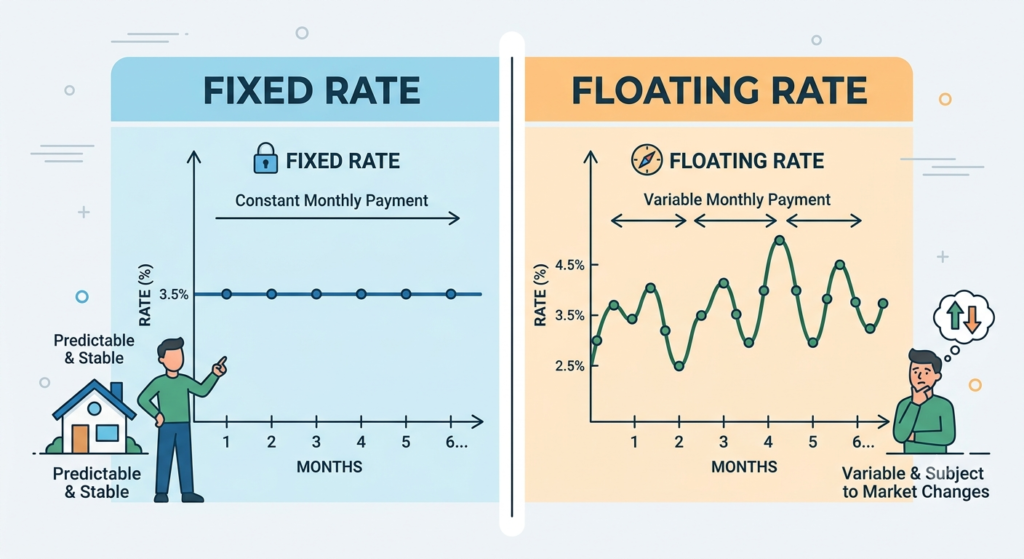
A fixed rate locks your EMI for the full tenure, trading a slightly higher starting rate for total predictability. A floating rate moves with a benchmark rate, which can lower your EMI in a falling-rate cycle or raise it without warning in a rising one.
If your monthly budget has little slack, a fixed rate protects you from a rate shock you can’t absorb. If your income is stable and you can tolerate variance, floating rates have historically cost less over a full multi-year cycle.
7. Employment Type and Income Stability
Salaried applicants with a consistent pay history are generally priced lower than self-employed applicants earning the same annual amount, because predictability, not just income size, drives the lender’s risk model.
Self-employed borrowers should expect additional documentation requests, tax filings or extended bank statements, before a final rate is confirmed.
8. Processing Fees and Add-On Charges
Processing fees don’t show up inside the EMI figure, but they change your effective cost of borrowing. Some lenders fold this into a higher advertised rate. Others charge it upfront as a flat percentage of the loan amount.
[CITATION CAPSULE] Comparing lenders on APR rather than the advertised interest rate captures fees automatically, since APR is required to include most mandatory charges, giving a more accurate side-by-side cost comparison.
Always compare total loan cost, not the EMI number alone, before signing.
How to Lower Your Personal Loan EMI
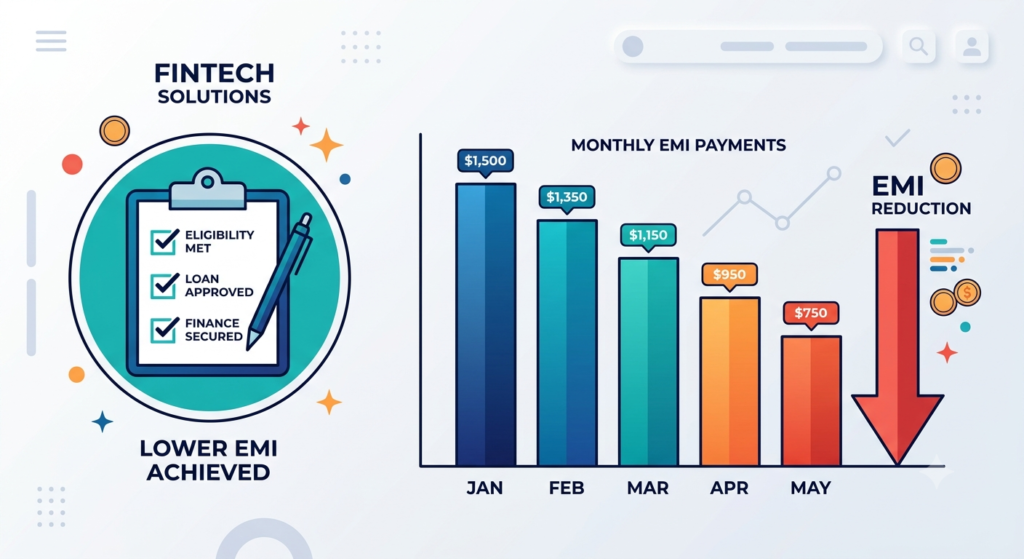
- Improve your credit score before applying, even a small gain helps.
- Choose the shortest tenure your budget can realistically support.
- Compare APR across at least three lenders; rates for the same profile can vary several points.
- Reduce the requested loan amount to only what you need.
- Keep your DTI under 36% before applying for new credit.
- Confirm prepayment terms so you can cut principal early without a penalty.
Test each scenario on the calculator before deciding. Small changes in any one factor move your monthly number more than most borrowers expect.
FAQs
What is the rule for EMI of a personal loan?
EMI is calculated from loan amount, interest rate, and tenure using a standard reducing-balance formula, where the interest portion shrinks and the principal portion grows with each payment (internal calculation).
What factors affect personal loan rates?
Credit score, income stability, existing debt (DTI), loan tenure, and the lender’s own risk model all shape your quoted rate, with credit score carrying the most weight (NerdWallet, 2026).
What are the 3 Cs for a loan?
Character, capacity, and collateral: character reflects credit history, capacity reflects income and repayment ability, and collateral applies mainly to secured loans since most personal loans are unsecured.
Which factors affect the EMI amount directly?
Loan amount, interest rate, and tenure are the three direct inputs into the EMI formula. Credit score and DTI affect EMI indirectly, by determining which rate you’re offered in the first place.
How do you increase the EMI amount?
Choose a shorter tenure, or make voluntary prepayments that cut your outstanding principal and reduce future interest, both of which raise the effective monthly commitment.
What factors affect loan payments overall?
The same core three, principal, rate, tenure, plus processing fees and prepayment terms, which shift total cost even when the advertised EMI figure looks identical across lenders.
Final Word
Your EMI is not handed down at random. It is the output of eight variables you can influence before you ever sign a loan agreement.
Check your credit score first. Compare APR, not just the headline rate, across several lenders. Then confirm your exact numbers on the personal loan calculator before committing to a tenure.