
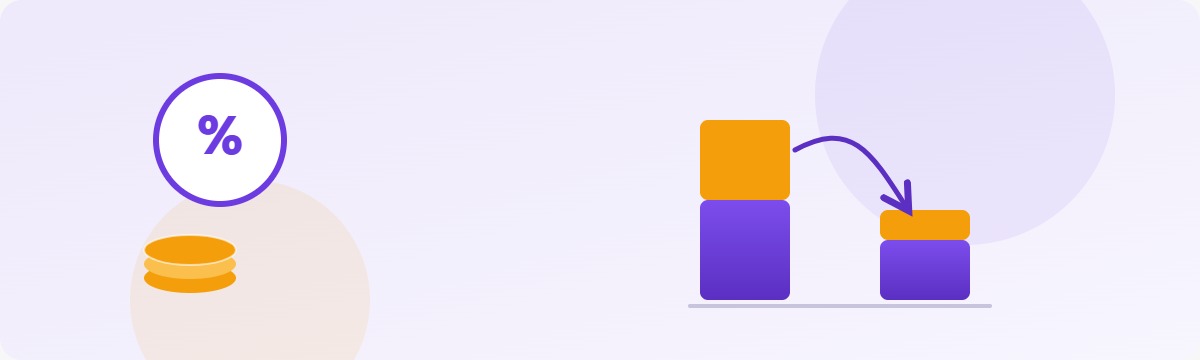
A loan prepayment calculator shows how much you save when you pay more than your scheduled amount, either as extra each month or as a one time lump sum. On a normal reducing balance loan, every extra payment lowers the balance that interest is charged on, so you cut the total interest and finish the loan sooner. This tool works for more than 70 currencies and is part of our interest calculators.
How to use the prepayment calculator
- Enter your loan amount, interest rate, and remaining term.
- Add an extra amount per month, or a one time lump sum.
- Read your results: the new payoff time, the new total interest, and how much you save.
What is loan prepayment?
Prepayment means paying off part or all of your loan ahead of schedule. A part prepayment is an extra amount on top of your normal payment, while a full prepayment or foreclosure clears the whole balance at once. You can prepay regularly, for example a little extra every month, or as a single lump sum when you receive a bonus or savings.
How prepayment saves you money
On a reducing balance loan, interest each month is charged on the balance you still owe. When you pay extra, that balance drops straight away, so less interest is charged in every month that follows. The effect builds over the life of the loan, which is why even small extra payments add up to large savings, and why prepaying early saves the most.
How much can you save?
Here is what happens to a 100,000 loan at 10% over a 15 year term when you add a little extra each month. The normal payment is about 1,075.
| Extra per month | Loan paid off in | Total interest | Interest saved |
|---|---|---|---|
| None | 15 years | about 93,429 | baseline |
| +100 | 12 years 5 months | about 74,944 | about 18,485 |
| +200 | 10 years 8 months | about 62,917 | about 30,512 |
| +300 | 9 years 5 months | about 54,377 | about 39,052 |
Just a small extra payment each month clears the loan years earlier and saves a large amount of interest. A one time lump sum early in the loan works in the same way.
Reduce the term or reduce the payment?
After a lump sum prepayment, lenders usually offer two choices:
- Keep the payment the same and shorten the term. You finish earlier and save the most interest.
- Keep the term the same and lower the payment. Your monthly cost falls, which helps cash flow but saves less interest.
If your goal is to save the most money, choose to shorten the term.
Prepayment fees and rules
Some lenders charge a prepayment or foreclosure fee, so always check your loan agreement first. In several countries, regulators limit or ban these fees on floating rate personal and home loans, but fixed rate loans and business loans may still carry a charge. Confirm the current rules with your lender before you make a large extra payment.
When does prepayment make sense?
- Early in the loan, when the interest part of each payment is largest.
- When your loan rate is higher than what you could earn by saving or investing the money.
- When there is no large penalty that cancels out the saving.
- After keeping an emergency fund, so you do not leave yourself short of cash.
Prepayment on a flat rate loan
The savings above apply to reducing balance loans. On a flat rate loan, interest is often fixed at the start, so paying early may not reduce it at all. Check the method first. To compare the methods, see our reducing balance calculator, build a full amortization schedule, or find the true rate with the effective interest rate calculator.
Loans around the world
Rules and fees differ by country, so always check current terms with local lenders. See examples and currencies for your country:
Pakistan (PKR) · India (INR) · UAE (AED) · Saudi Arabia (SAR) · United Kingdom (GBP) · All countries
Frequently asked questions
What is loan prepayment?
Does prepaying a loan save money?
Should I reduce the term or reduce the EMI after prepaying?
Is there a penalty for prepaying a loan?
When is the best time to prepay?
Does prepayment help on a flat rate loan?
Built and maintained by Hira Fatima, BSc in Computer Science (BSCS)
Hira builds, tests, and maintains the calculators on loancalc.io and writes the guides that go with them.
How we calculate: Reducing balance uses the standard EMI formula; flat rate charges interest on the full original amount. | Last updated: June 2026
Disclaimer: This calculator gives estimates for planning only and is not financial advice. Your actual figures may differ due to fees, taxes, and lender policies. Confirm with your bank or lender before you borrow.