
If you are weighing flat rate vs reducing balance UAE loan offers, the pricing method your bank uses matters far more than the headline percentage, because the same number can mean very different costs. A flat rate and a reducing balance rate are two ways of charging interest, and a 5 percent flat loan is not the cheaper cousin of a 5 percent reducing balance loan. In most cases it costs close to double. This guide explains both methods in plain English, walks through a real example in dirhams, and shows you how to put any two offers on an equal footing before you sign.
What a flat rate actually charges
A flat rate charges interest on the full original loan amount for the entire tenure, even though you are paying the balance down every month. The bank fixes the interest on day one and never recalculates it. That is why a flat rate looks so attractive on a poster: the number is small, but it is applied to the whole amount for the whole period. If you want the formal definition, the flat rate finance explainer on Wikipedia sets out the same idea.
The formula is simple. Total interest equals principal times the flat rate times the number of years. Your monthly instalment is then the principal plus that total interest, divided by the number of months. Because the interest never shrinks as your balance shrinks, you keep paying for money you have already repaid.
What a reducing balance rate actually charges
A reducing balance rate, also called a diminishing balance rate, charges interest only on the amount you still owe. Each month, part of your instalment clears interest and the rest clears principal. As the principal falls, the interest portion falls with it, so later instalments carry much less interest than the early ones. This is the method behind a normal mortgage and behind most EMI calculations.
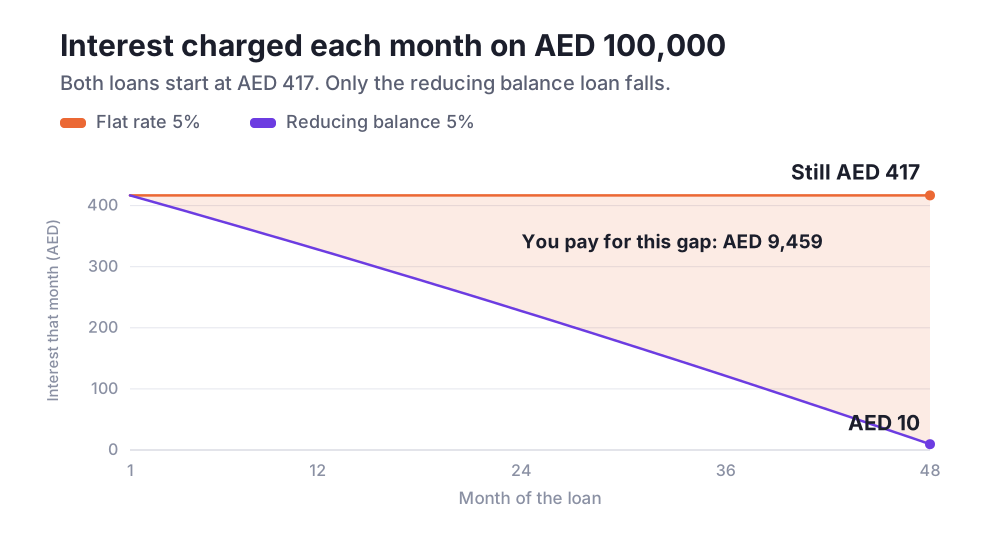
The quoted percentage on a reducing balance loan is the honest one, because it tracks your real debt. When you see an annual percentage rate, or APR, it is based on the reducing balance method. That is the number regulators want you to compare, and it is the number you should ask for.
Flat rate vs reducing balance UAE: which is cheaper
At the same quoted percentage, a reducing balance loan is always cheaper for you than a flat rate loan. A 5 percent reducing balance loan costs far less than a 5 percent flat loan, because the reducing method stops charging you for money you have already paid back. The flat rate only looks cheaper because the percentage is calculated on a bigger base.
The trap in the UAE market is that these two numbers sit side by side in advertising. One bank quotes a low flat rate, another quotes a higher reducing rate, and the flat rate wins the eye test while quietly costing more. To compare them fairly you have to convert the flat rate into its real reducing balance equivalent, which is what the example below does.
A worked example in dirhams
Imagine you borrow AED 100,000 over 4 years, which is 48 months. Here is how the two methods compare.
- Flat rate at 5 percent: interest is 100,000 times 0.05 times 4, which is AED 20,000. Total repayable is AED 120,000, so your monthly instalment is 120,000 divided by 48, which is AED 2,500.
- Reducing balance at 5 percent: the same 5 percent applied to the falling balance gives a monthly instalment of about AED 2,303 and total interest of roughly AED 10,541.
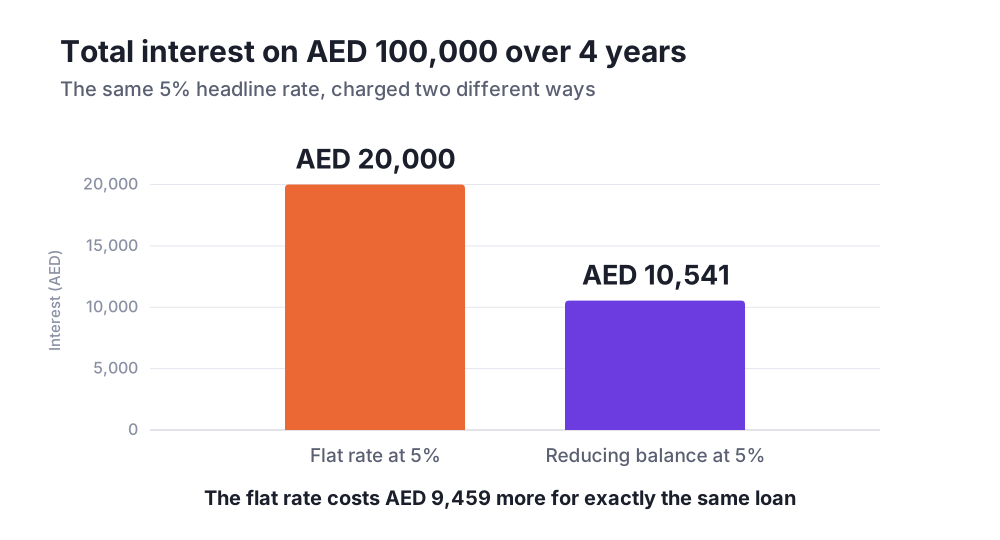
Same loan, same headline percentage, but the flat rate costs about AED 9,459 more in interest. Now flip the question. What reducing balance rate would give you that AED 2,500 flat instalment? The answer is roughly 9.2 percent as a nominal annual rate, or about 9.64 percent once you express it as an APR. In other words, a 5 percent flat rate is really close to a 9.6 percent reducing balance rate. The flat number was never the real cost.
How to turn a flat rate into its real rate
You do not need heavy maths to protect yourself. A reliable rule of thumb is that the real reducing balance rate is roughly 1.8 to 2.0 times the flat rate for typical personal loan tenures of three to five years. So a 4 percent flat rate behaves like about 7.5 percent reducing, and a 6 percent flat rate behaves like about 11 percent reducing.
For an exact figure rather than an estimate, run the numbers through the effective interest rate calculator, or compare the instalments directly using the flat rate loan calculator and the reducing balance calculator. If you are borrowing locally, the UAE loan and EMI calculator lets you test both methods in dirhams before you commit.
Why UAE banks still quote flat rates
Flat rates survive because they market well. A 4 percent flat rate reads as cheaper than a 7 percent reducing rate, even though they can cost the same, and that first impression wins a lot of applications. The number is also easy to print on a billboard without explaining the maths behind it.
The good news is that the Central Bank of the UAE requires lenders to disclose the reducing balance rate and the APR, so the honest figure is always available if you ask for it. The reduced rate may be printed lower down in the schedule of charges or in the key facts statement rather than in the headline. Your job is simply to find it and compare on that basis.
How to compare two UAE loan offers correctly
- Always ask each bank for the reducing balance rate or the APR, not just the flat rate.
- If a bank only gives you a flat rate, convert it using the rule of thumb above or a calculator before comparing.
- Compare the total amount repayable over the full tenure, not only the monthly instalment, because a smaller instalment over a longer term can still cost more.
- Check the processing fee, early settlement charge, and any insurance that is bundled in, since these can swing the real cost by thousands of dirhams.
- Match the tenure before you compare. A 3 year and a 5 year offer are never a like for like comparison.
Do those five things and the cheaper loan becomes obvious very quickly, no matter how the rate is dressed up.
Frequently asked questions
Is a flat rate ever better than a reducing balance rate?
At the same percentage, no. A flat rate only wins if its number is so much lower than the reducing rate that the real converted cost still comes out ahead. Always convert the flat rate first, then decide.
How do I convert a UAE flat rate to a reducing balance rate?
Multiply the flat rate by roughly 1.8 to 2.0 for a three to five year loan to get a quick estimate, or use an effective interest rate calculator for the exact figure. A 5 percent flat rate works out close to 9.6 percent reducing.
Which rate do UAE banks legally have to show?
Lenders in the UAE are required to disclose the reducing balance rate and the APR so borrowers can compare offers fairly. If you only see a flat rate in an advert, ask for the reducing balance figure in writing.
Does early settlement help more on a flat or reducing loan?
Early settlement helps on both, but the benefit is clearer on a reducing balance loan because future interest is tied to the balance you clear. On a flat rate loan the interest was fixed upfront, so check whether early settlement actually refunds any of it.
Why is my flat rate instalment higher than a friend’s reducing rate instalment at the same percentage?
Because your interest is charged on the full original amount for the whole term, while your friend’s interest shrinks as their balance falls. The percentages look identical but they are measuring two different things.
Written by Hira Fatima, who builds and tests the calculators on loancalc.io.