
You borrow $10,000. Your statement says you owe $11,400. Where did that extra $1,400 come from? Confused how loan interest works? See the exact formula, real examples, and costly mistakes to avoid. Calculate your true loan cost free, in seconds.
That’s interesting. It’s the price tag on borrowed money. And how it’s calculated decides whether your loan is cheap or quietly expensive.
This guide breaks down exactly how loan interest works, step by step, with real numbers. No jargon. No fluff. Just the math your lender doesn’t explain clearly.
What Loan Interest Actually Is
Interest is the cost of using someone else’s money.
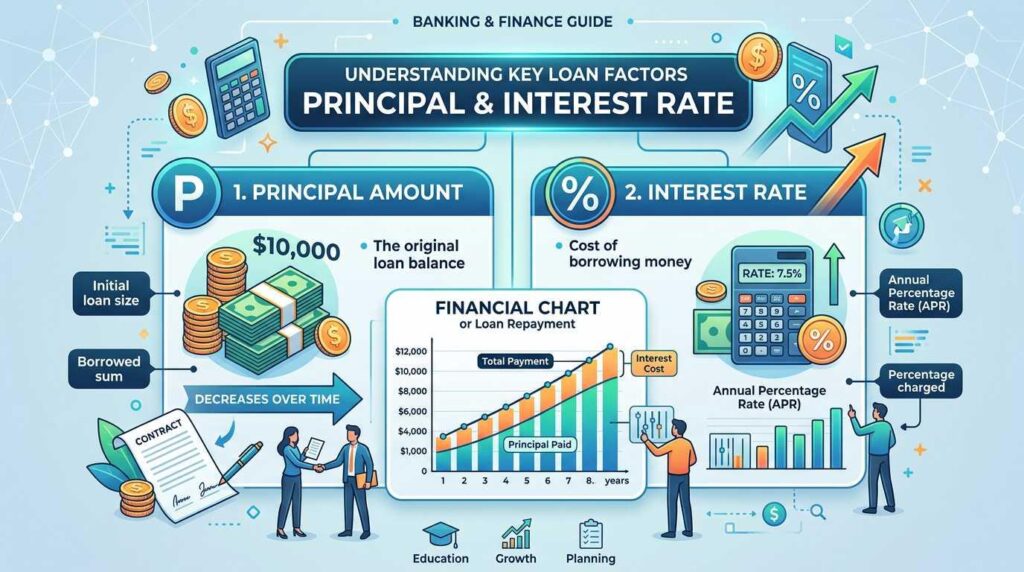
Your lender hands you a lump sum. In return, you pay back the principal (what you borrowed) plus a percentage on top. That percentage is your interest rate.
Think of it like renting money instead of a car. The longer you keep it, and the higher the rate, the more rent you pay.
The Two Numbers That Decide Your Cost
Every loan boils down to two variables:
- Principal the amount you borrowed
- Interest rate the percentage charged on that principal, usually shown as APR (Annual Percentage Rate)
A higher principal means more interest in raw dollars. A higher rate means more interest per dollar borrowed. Lenders combine both to set your monthly payment.
How Lenders Calculate Interest: The Two Main Methods
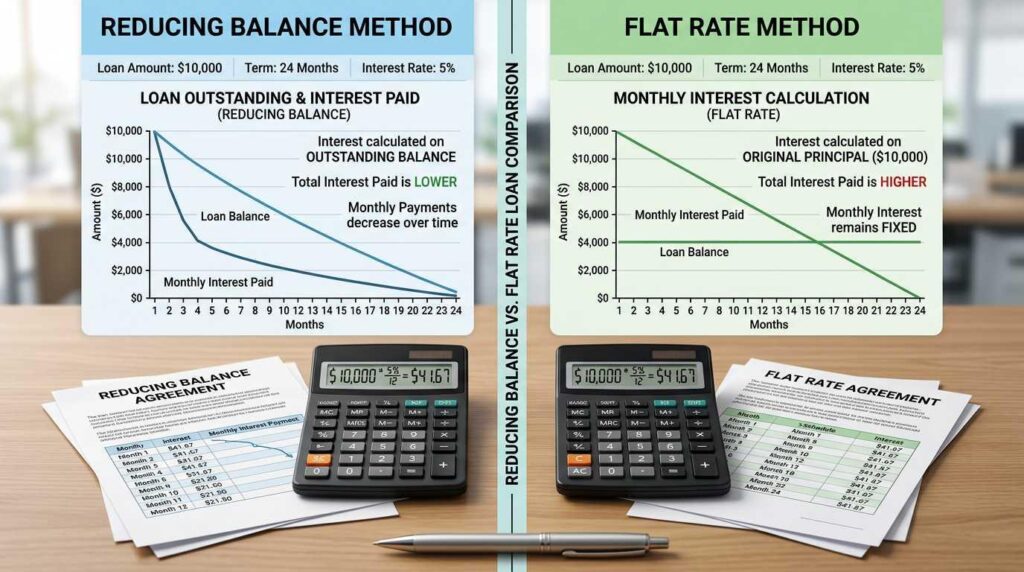
Not all loans charge interest the same way. Here are the two methods you’ll run into.
Reducing Balance Method (Most Common)
This is the standard method for mortgages, personal loans, and most instalment loans.
Here, interest is charged only on what you still owe, not on the original amount. Each payment shrinks your balance, so next month’s interest charge shrinks too.
Formula lenders use:
EMI = [P × R × (1+R)^N] / [(1+R)^N − 1]
Where:
- P = Principal
- R = Monthly interest rate (annual rate ÷ 12)
- N = Number of monthly payments
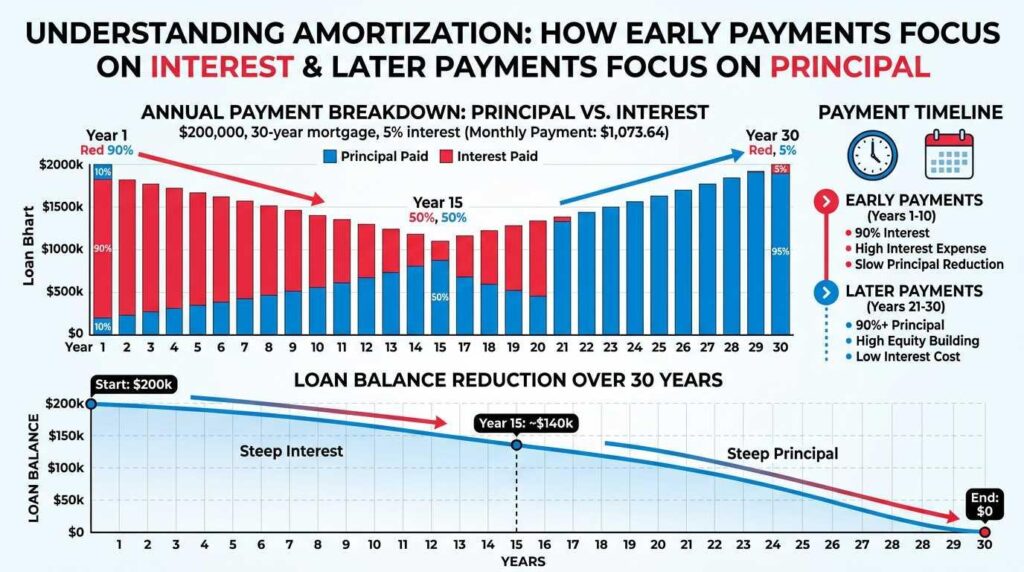
Early in the loan, most of your payment covers interest. Later, more goes toward principal. This pattern is called amortization.
Flat Rate Method
Some auto loans and short-term loans use flat rate interest. Here, interest is calculated on the full original amount for the entire loan term, even as you pay it down.
This method almost always costs more than reducing balance, for the same stated rate. A “10% flat rate” loan can carry a true cost closer to 18-19% APR.
Quick rule: if a lender advertises a flat rate, always ask for the equivalent APR before signing.
A Real Example: $10,000 Loan at 8% for 3 Years

Let’s make this concrete.
- Loan amount: $10,000
- Interest rate: 8% APR
- Term: 36 months
- Monthly payment: roughly $313
Over 3 years, you’d pay about $1,280 in total interest, on top of repaying the $10,000 principal. Your total repayment lands near $11,280.
Stretch that same loan to 5 years, and your monthly payment drops, but total interest climbs to roughly $2,165. Lower payments often mean a higher total cost.
This is exactly why checking your numbers before signing matters. You can run your own scenario using a loan and EMI calculator to see the full month-by-month breakdown.
Why Your First Payments Are Mostly Interest
This trips up most borrowers.
In a reducing balance loan, your payment amount stays the same each month, but what it covers shifts over time. Month 1, a big chunk pays interest. Month 36, almost all of it pays principal.
Why? Interest is calculated on your remaining balance. Early on, that balance is high, so the interest portion is high too. As the balance drops, so does the interest charged, leaving more of each fixed payment to attack the principal.
This is also why making extra payments early in a loan saves you the most money. You’re cutting down the balance interest gets calculated on, sooner.
What Affects Your Interest Rate
Lenders don’t pull your rate from thin air. Several factors drive it:
- Credit score: higher scores typically unlock lower rates
- Loan term: shorter terms often carry lower rates but higher monthly payments
- Loan type: secured loans (backed by collateral) usually cost less than unsecured ones
- Market rates: central bank benchmark rates shift what lenders charge across the board
- Lender risk policy: each lender weighs risk differently, so rates vary even for identical borrowers
Two people with the same credit score can get different rates from different lenders. Shopping around isn’t optional if you want the best deal.
Simple Interest vs. Compound Interest
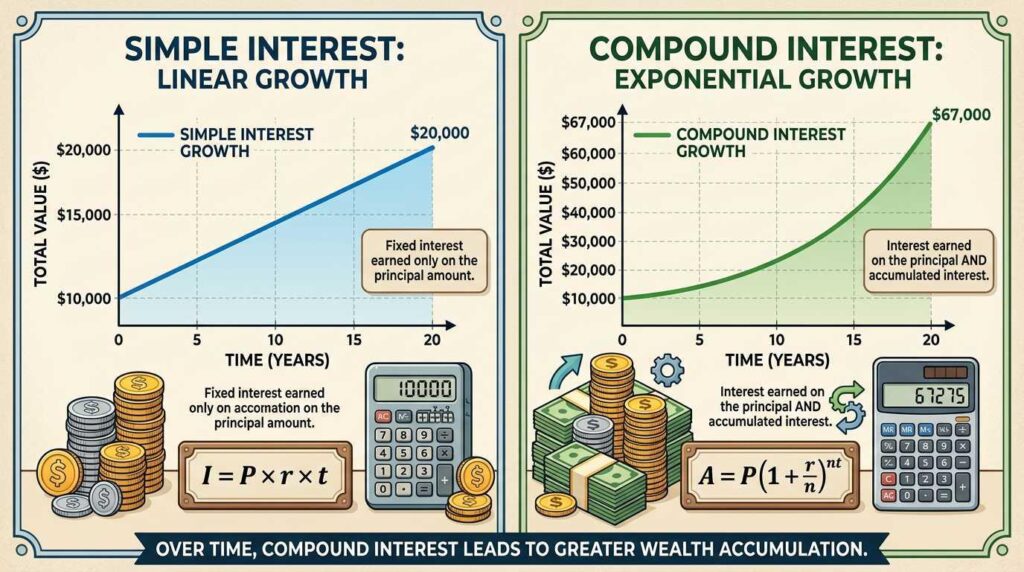
These two terms get mixed up constantly.
Simple interest is calculated only on the principal. It’s common in personal loans and some auto loans.
Compound interest is calculated on the principal plus any interest already added. It’s common in credit cards and some student loans, and it grows faster, especially if you miss payments and unpaid interest gets added to your balance.
If a loan offer doesn’t specify which type applies, ask. The difference compounds, literally, over the life of the loan.
Reading Your Amortization Schedule
An amortization schedule lists every payment over your loan term, split into principal and interest.
Each row typically shows:
- Payment number and date
- Total payment amount
- Interest portion
- Principal portion
- Remaining balance
Scan the first few rows of any amortization table and you’ll notice the interest column starts high. Scroll to the final rows, and it’s nearly zero. That shift happens automatically, driven purely by your shrinking balance.

Why does this matter to you? Two reasons.
- First, if you plan to sell or refinance in a few years, an amortization schedule shows exactly how much equity you’ll have built versus how much you’ve spent on interest. Early payoff often means you’ve paid more in interest than principal reduction, especially in years one and two.
- Second, it reveals the real cost of “teaser” low monthly payments. A longer term lowers your monthly bill but stretches out the high-interest early phase, costing more over the full loan life.
Most lenders provide this schedule on request, but you don’t need to wait. Generating one yourself, before signing anything, lets you compare offers side by side using identical assumptions.
How to Pay Less Interest Overall
A few practical moves cut your total interest cost:
- Choose a shorter term. Less time for interest to accrue, even if the monthly payment is higher.
- Make extra principal payments. Every extra dollar toward principal reduces the balance interest is calculated on.
- Improve your credit score before applying. Even a 0.5% rate drop saves real money on large loans.
- Compare APR, not just the headline rate. APR includes fees, giving you the true cost.
- Avoid flat rate loans when reducing balance options exist. Same stated rate, different real cost.
Mistakes That Quietly Increase Your Interest Cost
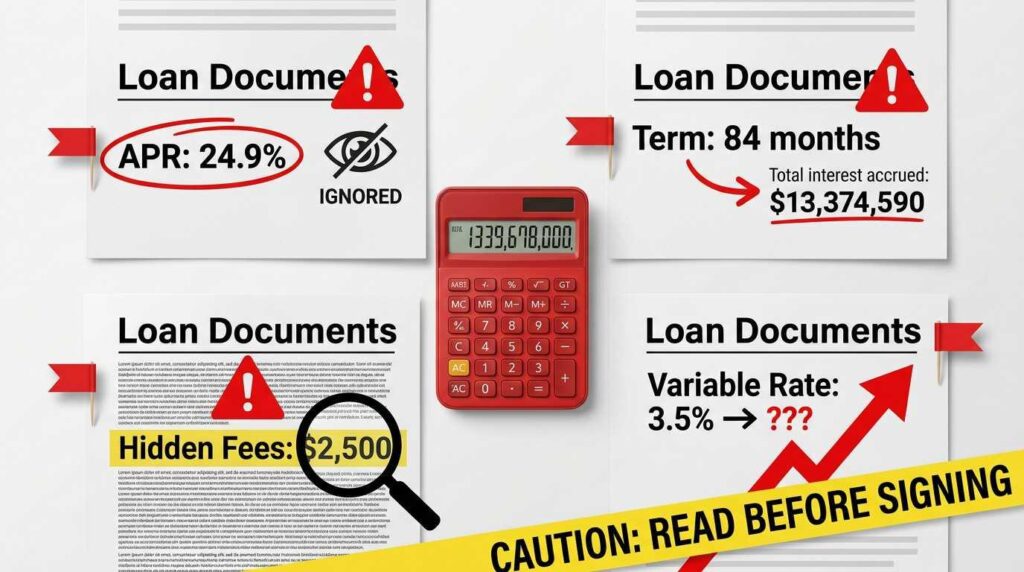
A few habits push your total interest higher without you noticing:
- Skipping the APR comparison. Two loans with the same interest rate can have different APRs once fees are added. Always compare APR, not the headline rate alone.
- Choosing the longest term available by default. Lower monthly payments feel safer, but they extend the high-interest phase of your loan.
- Ignoring prepayment penalties. Some loans charge a fee for paying early, which can offset the interest you’d save. Check your contract before making extra payments.
- Letting a variable rate loan run unchecked. If your rate is variable, a rate hike increases your interest cost going forward, even on your existing balance.
None of these mistakes are obvious from a single monthly statement. They show up only when you look at the full schedule.
Check Your Exact Numbers
Reading about loan interest only gets you so far. Your actual numbers depend on your principal, rate, and term.
Run your own loan through our interest calculators to see your monthly payment, total interest, and full amortization schedule in seconds, free, no signup required.
FAQs
How much is 4% interest on $10,000?
At 4% annual interest on $10,000, simple interest for one year equals $400. On a reducing balance loan, the exact amount depends on your term and payment schedule, since interest is recalculated on the shrinking balance each month.
How is interest charged on a loan?
Most lenders charge interest using the reducing balance method, calculating it on your remaining principal each month. Some short-term and auto loans use flat rate interest instead, charging on the original amount for the full term.
What is the 7% interest for 1 lakh?
At 7% annual interest on 1 lakh (100,000), simple interest for one year equals 7,000. On an EMI-based loan, your actual interest cost depends on the loan term and reducing balance calculation.
What is 6% interest on $30,000?
At 6% annual interest on $30,000, simple interest for one year equals $1,800. For installment loans, total interest paid depends on your repayment term, since reducing balance loans charge less interest as your balance drops.
How do banks calculate interest on a loan?
Banks typically use the reducing balance method, applying your interest rate to the outstanding principal each period. They convert your annual rate into a monthly rate, then apply the EMI formula to set a fixed monthly payment covering both interest and principal.
How does interest work on a student loan?
Student loans often use simple daily interest, accruing based on your principal balance each day. Some types capitalize unpaid interest, adding it to your principal, which means future interest is calculated on a higher balance if payments are deferred.
How do banks set interest rates on loans?
Banks set rates based on a benchmark rate, your credit profile, the loan type, and current market conditions. Riskier loans or borrowers with lower credit scores are charged higher rates to offset the bank’s risk.
What is the interest rate in a bank?
A bank’s interest rate is the percentage charged on borrowed money, or paid on deposited money, expressed annually as APR or APY. It reflects the cost of borrowing or the reward for saving, set by the bank based on market and risk factors.
Disclaimer: This article is for general information only and isn’t financial advice. Your actual loan costs depend on your lender’s terms, fees, and your credit profile. Confirm exact figures with your lender before borrowing.