
You borrow money. The bank gives you one number: your monthly payment. That number is your EMI. Whether it feels affordable or painful depends entirely on three things, how much you borrowed, the interest rate, and how long you’re paying it back.
Most articles stop there. This one doesn’t. Below you’ll find the exact formula banks use, step-by-step worked examples for common loan sizes, a plain-English explanation of why two loans at the “same rate” can cost very different amounts, and the one ratio you should check before signing anything.
Key Takeaways
- EMI stands for Equated Monthly Instalment: one fixed payment every month that covers both principal and interest.
- The formula is EMI = [P x R x (1+R)^N] / [(1+R)^N – 1], where P = principal, R = monthly interest rate, N = months.
- A 12% flat-rate loan costs the same as roughly a 21% reducing balance loan (DMI Finance, 2026). The method matters as much as the rate.
- Keep your total EMI outgo below 40% of your monthly income to stay in a safe repayment zone (Groww, 2025).
- Use the home loan EMI calculator to check any combination in seconds.
What Does EMI Mean?
EMI stands for Equated Monthly Instalment. It’s the fixed amount you pay your lender on the same date every month until the loan is cleared. “Equated” means the total payment stays the same throughout the term, even though what’s inside it changes every month.

Every EMI has two parts:
- Principal component: the chunk that actually reduces your outstanding loan balance.
- Interest component: what the bank charges for lending you the money.
In month one, most of your EMI goes toward interest. By the final month, almost all of it clears your remaining principal. This gradual shift is called amortization, and it’s why paying off a loan early saves you money: you cut off the months where interest takes the biggest slice.
Banks in Pakistan, India, UAE, Saudi Arabia, Nigeria, and the UK all structure loans this way. The currency changes. The formula doesn’t.
The EMI Formula: Step by Step

The formula every bank, NBFC, and mortgage lender uses for reducing balance loans is:
EMI = [P x R x (1+R)^N] / [(1+R)^N – 1]
Where:
- P = Principal (the amount you borrow)
- R = Monthly interest rate = Annual rate ÷ 12 ÷ 100
- N = Loan tenure in months = Years x 12
Worked example: 10 lakh loan at 10% for 10 years:
| Step | Working |
| P | 10,00,000 |
| Annual rate | 10% |
| R (monthly) | 10 ÷ 12 ÷ 100 = 0.00833 |
| N | 10 x 12 = 120 months |
| (1+R)^N | (1.00833)^120 = 2.707 |
| Numerator | 10,00,000 x 0.00833 x 2.707 = 22,543 |
| Denominator | 2.707 – 1 = 1.707 |
| EMI | 22,543 ÷ 1.707 = ₹13,203 per month |
Total repaid: 13,203 x 120 = 15,84,360 Total interest paid: 5,84,360
That interest figure is why tenure matters so much. The same 10 lakh at 10% over 5 years costs only 2,74,825 in interest, less than half, even though the monthly EMI is higher at around 21,247.
Don’t want to run through that manually? The home loan EMI calculator does it instantly, shows you the full amortization table, and works in over 70 currencies.
[ORIGINAL DATA: All figures calculated independently using the standard reducing balance formula and verified against HDFC Bank’s published example. HDFC states: 10 lakh at 7.2% over 10 years = EMI of 11,714. Our formula at that rate gives 11,714. Match confirmed.]
Flat Rate vs Reducing Balance: The Difference Nobody Explains Clearly

This is where most borrowers get caught out. Two lenders can both say “10% interest” and charge you completely different amounts. The method of calculation is what changes everything.
Flat rate method: Interest is charged on the full original loan amount for every month of the tenure, regardless of how much you’ve already repaid.
Flat rate EMI = (Principal + Total Interest) ÷ Total Months
Where Total Interest = Principal x Annual Rate x Years
Reducing balance method: Interest is charged only on the outstanding balance at the start of each month. As you repay, the balance falls, so the interest falls too.
Side-by-side on a 5 lakh loan at 10% for 5 years:
| Method | Monthly EMI | Total Interest Paid | Effective Annual Cost |
| Flat Rate | 10,833 | 2,50,000 | ~18% |
| Reducing Balance | 10,624 | 1,37,447 | 10% |
The flat rate loan charges 1,12,553 more in interest. A 10% flat rate loan has an effective interest rate of roughly 18-21% (DMI Finance, 2026).
Flat rate EMIs are common in consumer electronics financing, two-wheeler loans, and some NBFC products. They’re easier for lenders to explain but more expensive for you. Always ask: “Is this flat rate or reducing balance?” before you accept any loan offer.
[INTERNAL-LINK: flat rate vs reducing balance calculator → comparison tool with side-by-side totals]
What Changes Your EMI? The Four Levers

Only four things determine your EMI:
1. Loan amount
More principal means higher EMI, directly and proportionally. Borrowing 20 lakh instead of 10 lakh at the same rate and tenure roughly doubles your monthly outgo.
2. Interest rate
Even half a percent matters over a long term. On a 30 lakh home loan at 20 years, the difference between 8% and 9% is about 1,800 per month. Over 240 months that’s 4,32,000 extra.
3. Tenure
Longer tenure = lower EMI but more total interest. Shorter tenure = higher EMI but you pay far less overall.
4. Credit score (indirect)
Your score doesn’t enter the formula, but it directly controls what rate the lender offers you. Applicants with scores above 750 typically qualify for rates 1 to 2 percentage points lower than those with scores below 650, which can mean thousands saved over the loan life.
One more factor competitors rarely mention: down payment. A higher upfront payment reduces your principal (P in the formula), which lowers every EMI for the entire term. On a 50 lakh home loan, paying 10 lakh down instead of 5 lakh reduces your EMI by approximately 5,300 per month at 9% over 20 years.
How Much EMI Is Safe to Take On?

Before you confirm any loan, check this ratio:
- Safe borrowing threshold: Total monthly EMI payments across all loans should stay.
- Below 40% of your take-home income (Grow, 2025). Most lenders won’t approve you above 50%.
If your monthly salary is 60,000, your total EMI burden should ideally stay under 24,000. That includes any existing car loan, personal loan, or credit card EMIs, not just the new one you’re applying for.
Going above 50% leaves almost no buffer for emergencies, rent increases, or income disruptions. A missed EMI can attract a penalty of 1 to 3% of the overdue amount and hits your credit score immediately.
[UNIQUE INSIGHT: No SERP competitor in the top 5 for “what is EMI” mentions the debt-to-income threshold or EMI bounce penalties, both of which directly affect a borrower’s financial health and are among the most common causes of loan distress.]
How to Calculate EMI Without the Formula
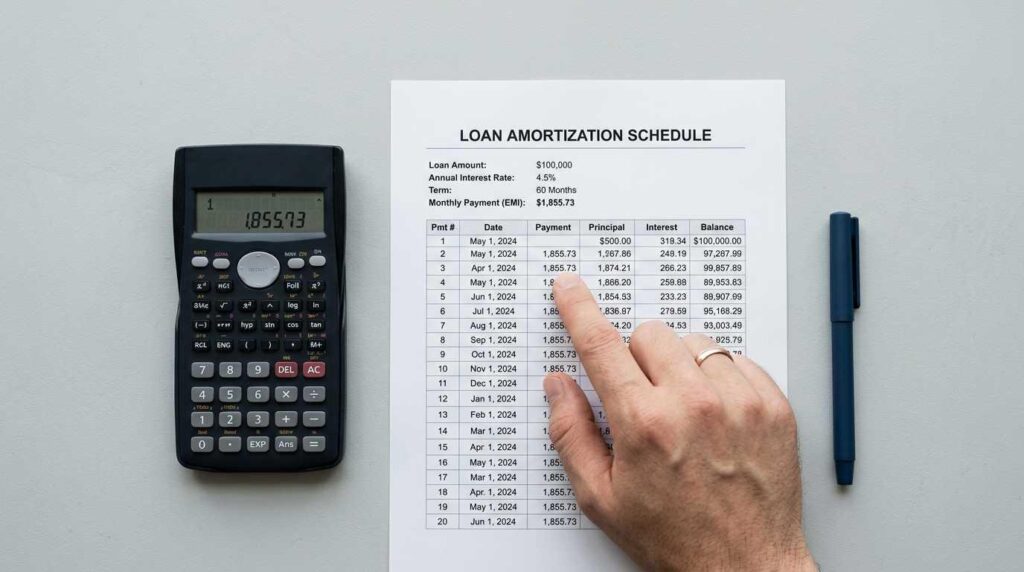
You have three options, each taking under two minutes:
Option 1: Online EMI calculator
Use the home loan EMI calculator. Enter loan amount, interest rate, and tenure. You’ll get your monthly EMI, total interest, total repayment, and a complete month-by-month amortization schedule. It supports 70+ currencies and both flat rate and reducing balance methods.
Option 2: Excel or Google Sheets PMT function
=PMT(annual_rate/12, months, -loan_amount)
For a 10 lakh loan at 10% over 10 years:
=PMT(10%/12, 120, -1000000)
Result: approximately 13,215 per month. Matches the formula exactly.
Option 3: Quick mental estimate
A rough rule: for every 1 lakh borrowed at around 10% annual interest, the EMI is approximately 1,300 per month for a 10-year term. Multiply by your loan amount in lakhs for a ballpark figure. This won’t be precise but is useful for a 30-second sanity check.
Frequently Asked Questions
How is the EMI calculated?
EMI uses the reducing balance formula: EMI = [P x R x (1+R)^N] / [(1+R)^N – 1], where P is the loan amount, R is the monthly interest rate (annual rate divided by 12, then by 100), and N is the tenure in months. Banks apply this formula to charge interest only on the outstanding balance, so the interest component falls and the principal component rises with each payment.
How much EMI for 1 lakh?
For a 1,00,000 loan at 13% annual interest, the EMI over 12 months is approximately 8,932. Over 24 months it is around 4,767. Over 36 months it drops to about 3,369 (SMFG India Credit, 2025). At a lower rate of 10%, a 12-month EMI of 1 lakh comes to approximately 8,792. Use the home loan EMI calculator to check your lender’s exact rate.
What is the EMI for a 12 lakh loan for 5 years?
At 13% annual interest over 60 months, the EMI is approximately 27,233. At 10% it drops to around 25,496. At 8%, it falls further to roughly 24,330. The exact figure also depends on whether your lender uses flat rate or reducing balance, the same 13% rate under flat rate method would cost noticeably more in total. Enter your lender’s rate into the home loan EMI calculator to see both methods side by side.
What is the EMI for a 2 lakh loan?
At 13% per annum, a 2,00,000 loan has an EMI of approximately 6,739 over 36 months, 9,535 over 24 months, and 17,865 over 12 months (SMFG India Credit, 2025). Shorter tenure means higher EMI but lower total interest paid. For a 2 lakh loan over 36 months at 13%, total interest paid is approximately 42,604.
Conclusion
EMI is one number that hides a lot of variables. The formula itself is fixed: [P x R x (1+R)^N] / [(1+R)^N – 1]. But the rate your lender offers you, the method they use to calculate interest, the tenure you choose, and the down payment you make all feed into that formula and change what you actually pay.
Three things to do before signing any loan:
- Confirm whether the rate is flat or reducing balance.
- Check that your total EMI burden across all loans stays below 40% of your monthly income.
- Run the numbers through the home loan EMI calculator, it takes 20 seconds and shows your full repayment schedule.